.svg)


.svg)
.svg)
.svg)
Fiberglass pools are a strong fit for the Upstate. A Latham shell installs in roughly four to eight weeks on a simple lot, and longer on a complex one. The gelcoat surface holds up well in Upstate clay because we backfill with gravel rather than reusing the excavated red clay. Pricing in 2026 starts around $70,000 to $75,000 for the shell and basics, stretching into the low $100,000s for a fully decked-out backyard. If you are in Greenville, Greer, Mauldin, Simpsonville, Easley, Anderson, or anywhere in between, this post is the dealer-side guide to what an Upstate fiberglass install actually looks like.
I am Stuart Lockhart, the General Manager of Hot Springs Pools & Spas. We have been building pools in the Carolinas since 1989, and the Greenville crew at our 578 Woodruff Road showroom drops Latham fiberglass shells into Upstate backyards almost every week of the build season. The post below is what I would tell you if you walked into the showroom this morning and said, "I am thinking about a fiberglass pool. What do I need to know?"
Why fiberglass works in the Upstate
Three things make a fiberglass pool the right call for a lot of Upstate homeowners. The first is speed. A Latham shell shows up in a single piece, drops in by crane in one day, and gets backfilled, plumbed, decked, and filled in the weeks that follow. The realistic timeline is four to eight weeks on a simple lot, longer on a complex one. A gunite pool in the same yard is a season-long project.
The second is the surface. Fiberglass has a smooth gelcoat finish from day one, which means less chemistry headache than a plaster gunite pool that has to be water-balanced carefully for the first year of its life. The third is how we build for the Upstate dirt. Red clay sounds intimidating, but a properly built fiberglass install does not rely on it. We backfill the area around the shell with gravel, which self-compacts and lets water channel through it instead of holding pressure against the shell. We have Latham shells in the ground from Spartanburg to Anderson that are aging gracefully because of how the gravel handles drainage and movement here.
What fiberglass is not is custom in the way a gunite pool is custom. The shape comes from Latham's mold catalog. You pick the shell, you do not draw it. If you want a freeform pool with a vanishing edge and a beach entry that follows a specific contour, you are probably a gunite buyer. If you want a clean, modern rectangular or kidney-shaped pool with a tanning ledge and bench seating, fiberglass will get you there for less money and in less time.
The Greer Corinthian 14 install
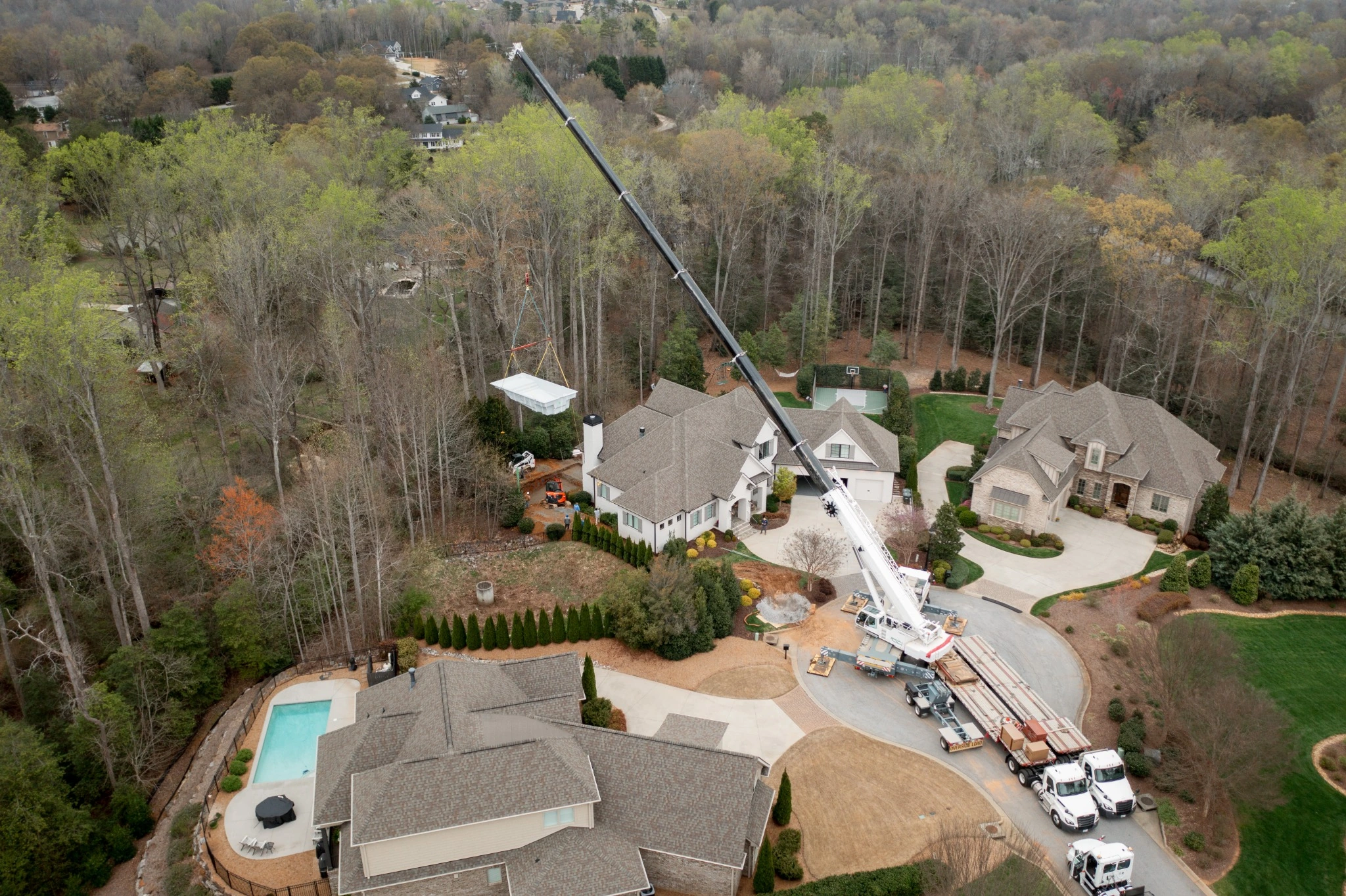
The most recent install that tells this whole story sits in a cul-de-sac in Greer. The homeowners came to us in March wanting a gunite pool, with one important constraint: their daughter's graduation party was at the end of May. We were honest with them. Gunite was not going to happen by Memorial Day. Fiberglass might.
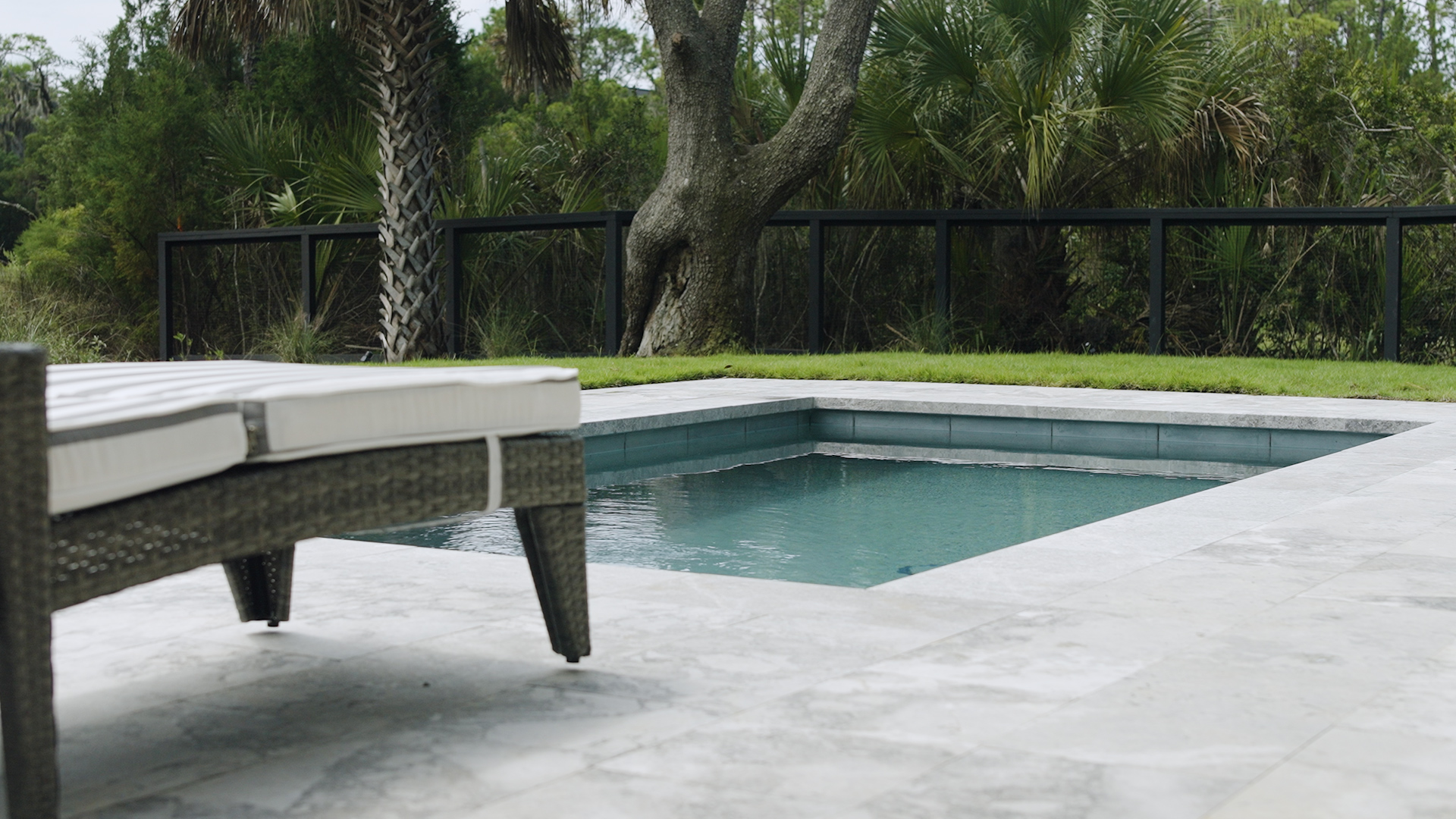
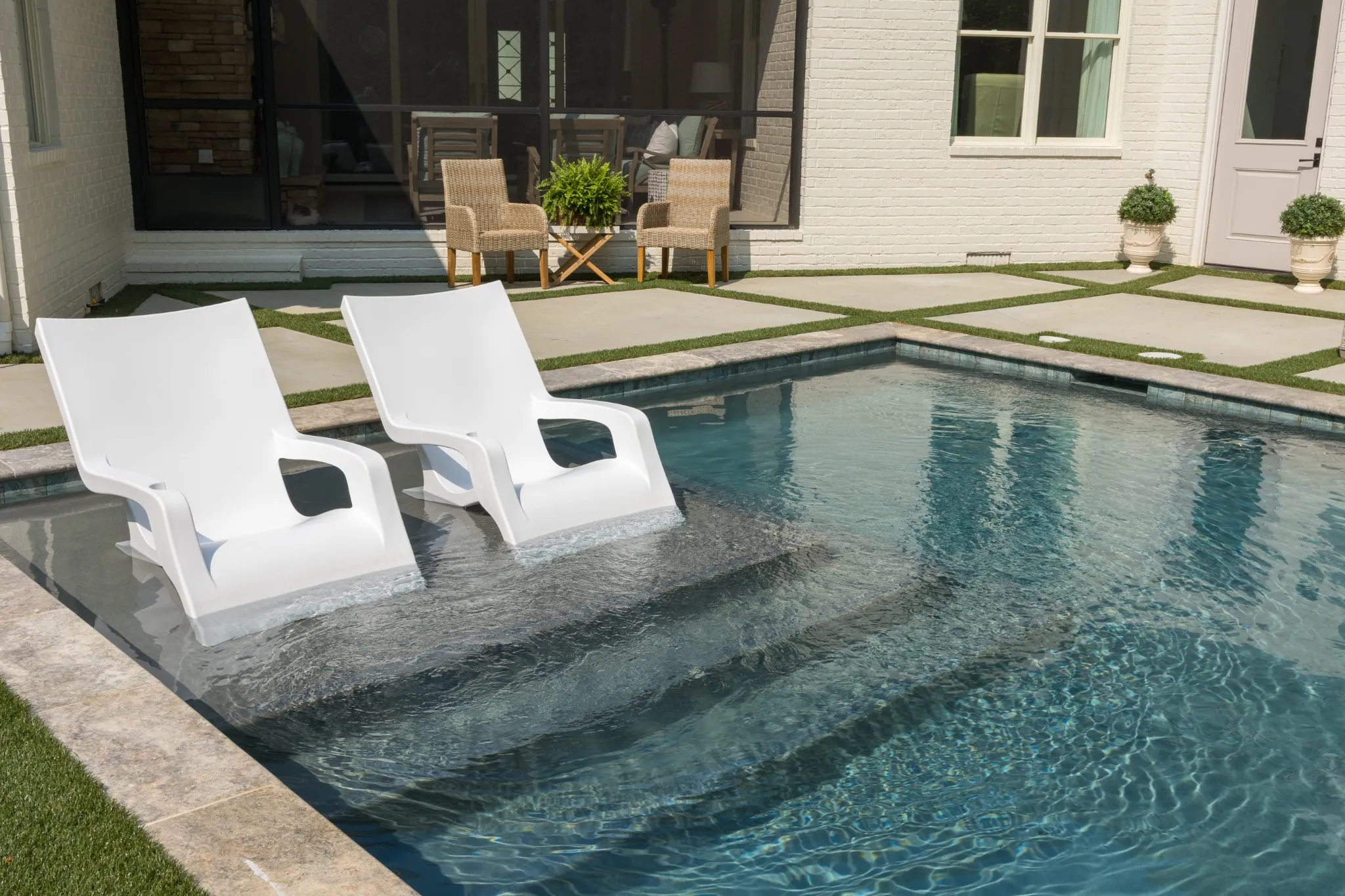
We sold them a Latham Corinthian 14 with an automatic cover, silver travertine coping, and turf around the pool for the decking. They signed the contract the last week of March. Permitting and the shell delivery took two to three weeks. Dig to finished pool took about another five weeks, slowed down by retaining walls (the grade on the side yard needed them), the custom travertine, the turf, and the auto cover install.
The install day itself was a piece of work. Access on the side of the house was tight, so we had to set the shell with a 100-ton crane and boom it over 100 linear feet of yard. The cul-de-sac filled up with three trucks: the crane and two counterweight haulers. Every neighbor was gracious about it, and nobody needed to leave during the setup, boom, set, and teardown (over an hour each on either end). Storm clouds rolled in right as the shell was settling into position. We got the pool set and the crane disconnected before any real lightning came through.
The homeowners had their graduation party with a swimming pool in the backyard, two weeks before the deadline. That is the version of fiberglass that works.
The red-clay reality nobody warns you about
The thing most Upstate customers walk in not understanding is how messy a pool construction site is during the build. Red clay gets everywhere. If you have dogs or cats, expect them to track it into the house. Tractors run back and forth between the back yard and the front yard where the dump truck is parked, and the ground they drive on gets chewed up over the course of weeks. We hauled a real amount of dirt out of the Greer job. The front yard, side yard, and back yard were all wrecked while the pool was going in.
One thing fiberglass buyers should understand specifically, because it differs from vinyl liner and gunite construction: we do not reuse the excavated red clay as backfill around the shell. We bring in gravel for the base under the shell and for the backfill around the sides. Gravel self-compacts as it settles and lets water channel through it instead of holding pressure against the shell, which is what you want under and around a fiberglass pool. The trade-off is that the excavated clay has to be hauled off site, because we are not using it. That means more dump truck loads leaving your driveway than a vinyl liner or gunite build would generate on the same lot. Plan for it.
The homeowners who do well with a fiberglass install are the ones who understand all of this going in. The yard is going to look terrible for a few weeks. Then the landscaper comes in at the end and puts everything back, often better than it was before. The Greer family trusted us through it, and the finished yard looked nothing like the work site that came before it. The ones who panic in the middle are the ones who make the project harder than it needs to be. If you are considering a pool in 2026, plan for the mess and budget for landscaping restoration on the back end. It is part of the job.
The Latham shells we actually install in the Upstate
We are a Latham fiberglass dealer, and we sell from the full catalog, but the shells we drop most often in Upstate yards are the Corinthian, the Astoria, and the Bermuda. The Corinthian (available in 12-, 14-, and 16-foot widths) is my personal favorite. The large tanning ledge and deep-end bench seats are the most functional layout we sell. The Astoria is a strong family pool with clean lines. The Bermuda has a freeform shape that fits a wider range of yard styles than a pure rectangle does.
Lead time on a Latham shell is typically three to four weeks from order to delivery, longer when peak season demand is up. That is materially better than where the industry was during the 2021 to 2023 supply chain crunch. We plan jobs around it and tell customers up front. One thing we do not do, even though some other builders will: add-on sundecks attached to a shell. We leave those to other dealers. They are not how we build.
If you want to see how the shells compare to a vinyl liner or gunite build at a deeper level, read our fiberglass vs. vinyl vs. gunite comparison for the differences across all three construction types. For Latham's own spec sheets and shell catalog, the manufacturer's site at lathampool.com is the canonical reference.
Realistic Upstate timelines from contract to first swim
The honest answer on timeline: a simple-lot fiberglass install in the Upstate runs roughly four to eight weeks from contract signature to first swim. Anything tighter than that is hard to pin down because the difference between a five-week job and a seven-week job comes down to three variables we cannot always control. Scope and site complexity is the first (a flat lot with poured concrete decking moves faster than the Greer job with retaining walls, custom travertine coping, turf, and an auto cover). Seasonal bandwidth is the second (the build calendar gets thick in late spring and early summer, and a contract signed in April competes with every other one signed that month). Weather is the third, and weather in the Upstate is its own creature: an extra week of rain in May can push a finish out by two.
For perspective, a gunite pool of similar size in the same Upstate yard is typically a four-to-six-month project once you account for shell construction, cure time, tile and coping, plaster, and final fill. The speed gap is real, and it is the single biggest reason a customer who wanted gunite ends up choosing fiberglass. If you want the pool in this swim season, fiberglass is the only construction method that can credibly promise it past about April first.
Permitting, HOAs, and the crane question
One thing worth saying directly: pool permitting in the Upstate is no different for fiberglass than it is for gunite or vinyl. Greenville County, the City of Greenville, Mauldin, Easley, Greer, Anderson, and Spartanburg all run their pool permits through similar processes. HOA review is similar across construction methods too. If your HOA is going to approve a pool, it is not going to discriminate on shell type. If it is going to object, it will object on placement, fencing, decking material, or screening, regardless of how the pool gets built.
The one place fiberglass is genuinely different is the crane. A Latham shell arrives as one rigid piece, and it has to be lifted into the hole by a crane. On the Greer install, that meant a 100-ton crane and over 100 feet of boom reach. If you live on a busy road where the city will not let us close a lane, or in a neighborhood where the only crane setup spot is a neighbor's driveway and the neighbor will not consent, the install can be a real problem. We scout this on the in-home site visit, and if a job is not crane-feasible, we will tell you before you sign anything. It is the most underrated practical question in fiberglass pool buying.
What a fiberglass pool actually costs in the Upstate
Pricing in 2026 starts around $70,000 to $75,000 for a fiberglass pool in the Upstate, and stretches into the low $100,000s for a standard pool with decking and the popular upgrades. Pool size is the biggest single driver of price. The bigger the shell, the bigger the number. Beyond size, the things that most often push pricing up are automatic covers (a worthwhile upgrade in my view), spas integrated with the pool, paver or travertine decking, and complex grading or retaining wall work on a sloped lot.
For the full pricing picture, including how fiberglass compares to vinyl liner and gunite costs across South Carolina, read our South Carolina inground pool cost guide. The short version: fiberglass is the lowest-friction construction type at the entry price point and stays competitive at the higher end. Gunite wins on customization. Vinyl can come in lower on raw price but carries liner replacement costs over time. None of those numbers are guarantees: every job is bid against the actual lot conditions, the shell choice, and the decking and equipment package you pick. Get a written quote.
If I were building one for my own Upstate backyard
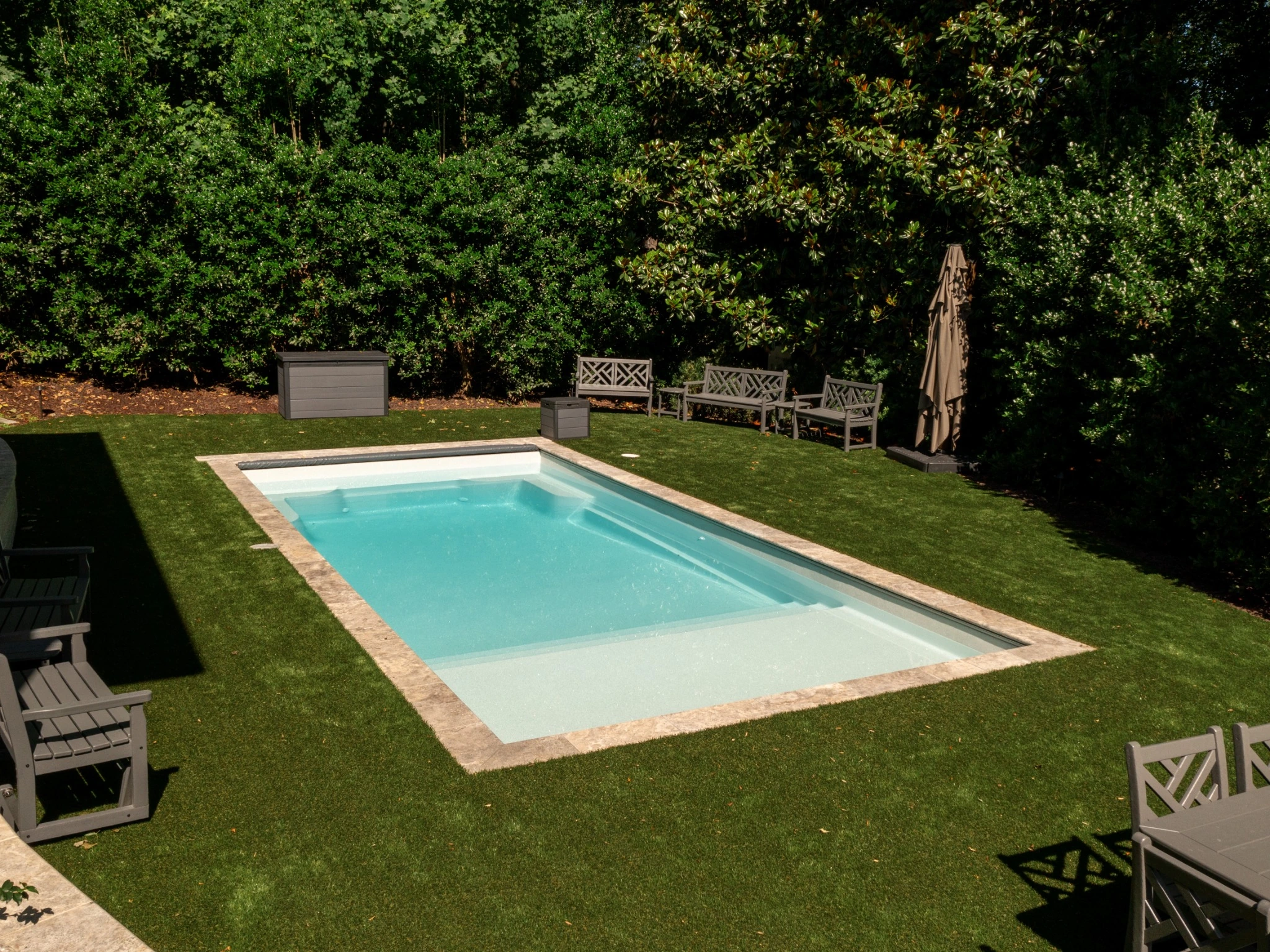
If I were putting a fiberglass pool in my own backyard somewhere in Five Forks or Simpsonville, I would pick a Corinthian shell. The tanning ledge and deep-end bench seats are the most functional layout we sell, and the design works at 12, 14, or 16 feet. I would pair it with an automatic cover, which is the single best upgrade for an Upstate family pool: cleaner water, lower heating cost, and safer when nobody is watching. For decking, I would seriously consider silver travertine coping with turf around the rest of the deck, the same combination we used on the Greer job. The look is clean and modern, and it works against most Upstate home styles.
What I would not do is try to save money on the things that age a pool fast. Cheap coping, undersized equipment pads, skipping the auto cover to save a few thousand dollars: those are the calls customers regret three years in. Spend the money on the things that touch the water and the things you see every day, and the pool will reward you for the next twenty years.
Service after the install
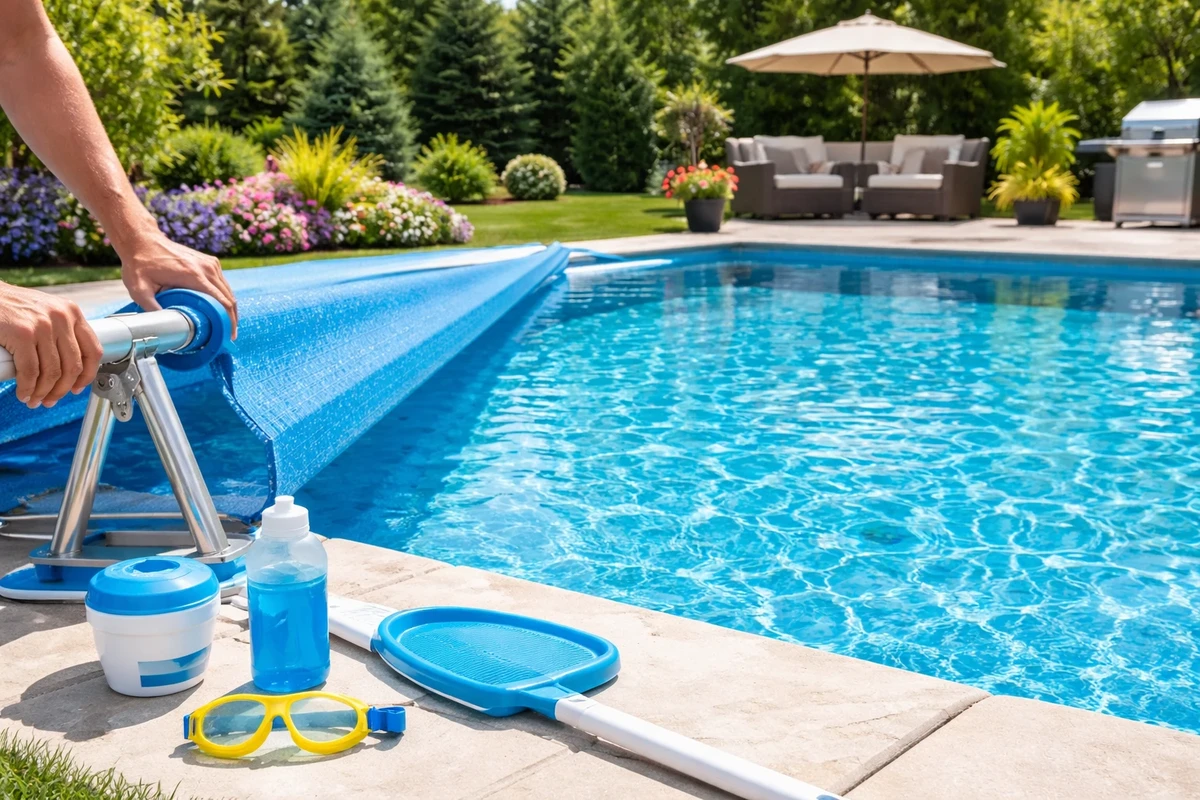
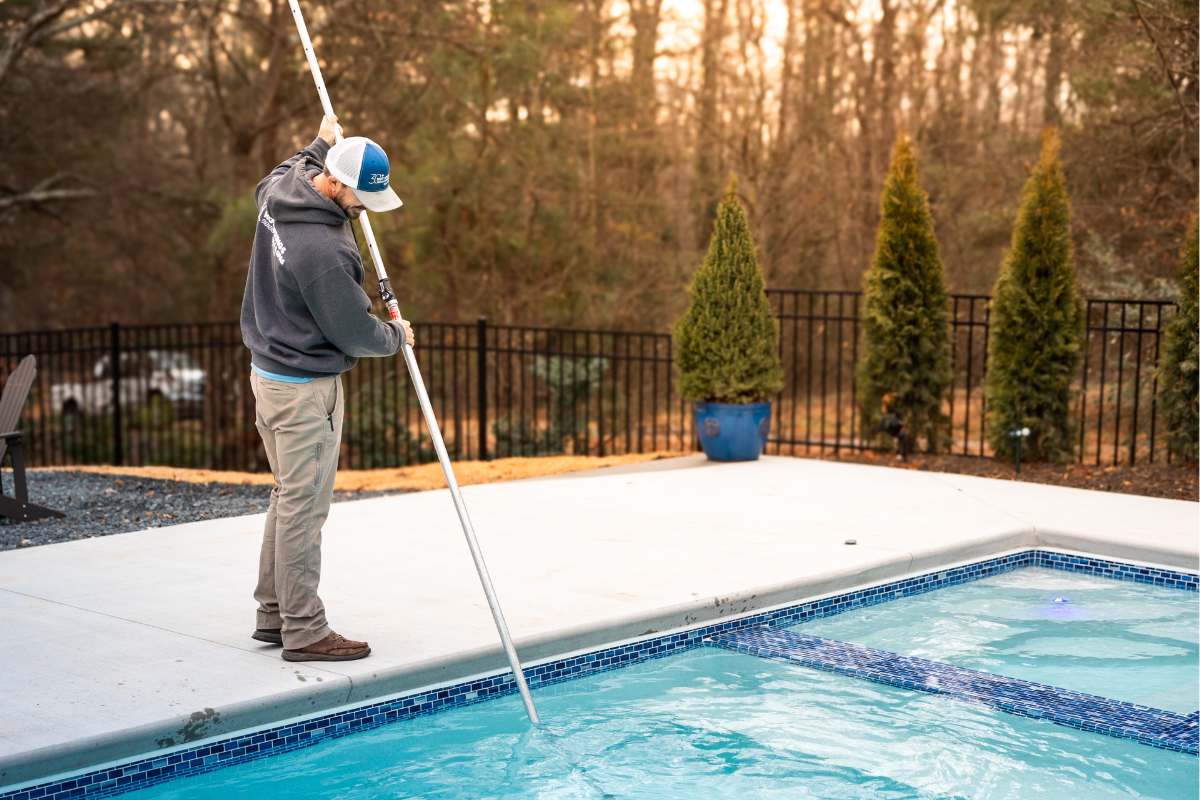
Every pool we build in the Upstate is supported by our service team out of the Greenville location. Pool service, cleanings, openings, closings, and equipment work all run out of the same Woodruff Road shop. If something goes wrong with a pump, a heater, or the auto cover mechanism, you call the team that put it in. That is the whole point of buying from a dealer that builds and services in the same market.
Frequently Asked Questions
How long does a fiberglass pool take to install in Greenville, SC?
Roughly four to eight weeks from contract signature to first swim on a simple-lot job. Complex jobs with retaining walls, custom decking, and an auto cover run longer. Pinning the timeline down tighter than that is hard because three things move it: scope and site complexity, our seasonal bandwidth, and Upstate weather. Compared to gunite, which is a four-to-six-month project, fiberglass is the only construction method that can credibly finish inside a single swim season once you are past early spring.
How much does a fiberglass pool cost in the Upstate?
Pricing in 2026 starts around $70,000 to $75,000 for a fiberglass pool in Greenville, Greer, Mauldin, Simpsonville, Easley, Anderson, Fountain Inn, or Spartanburg, and runs into the low $100,000s for a standard pool with paver decking and the popular upgrades. Pool size is the biggest driver. Auto covers, integrated spas, and travertine or paver decking add cost from there.
Do fiberglass pools hold up in Upstate red clay?
Yes, because we do not rely on the red clay. We backfill the area around a fiberglass shell with gravel, which self-compacts and lets water channel through it rather than pressing against the shell. The excavated clay gets hauled off site instead of being reused as backfill, which is different from how a vinyl liner or gunite pool gets built and means more dump truck loads leaving your driveway. Plan for the dirt haul and for landscaping restoration as part of the project budget.
What is the lead time on a Latham fiberglass shell in 2026?
Three to four weeks from order to delivery is typical. Peak-season demand can push it longer. We plan the rest of the install around the shell delivery so the crew is ready to set the day it arrives.
Will a fiberglass pool work on a sloped Upstate lot?
Often, yes, with retaining walls and engineered grading to handle the drop. The Greer job we describe above sat on a lot that needed retaining walls on the side yard. There is a slope at which gunite becomes a more practical choice, and that is a conversation worth having on the in-home site visit before you commit to a shell.
Can a fiberglass shell get into my neighborhood?
The shell arrives as one piece and is set with a crane that often needs 60 to 100 feet of boom reach. On a busy road or in a neighborhood where the crane setup spot is blocked, that can be a real problem. We scout crane access on every in-home site visit before any contract gets signed. If the lot is not crane-feasible, we tell you before you commit.
About the author
Stuart Lockhart is the General Manager of Hot Springs Pools & Spas, serving Western North Carolina and Upstate and Lowcountry South Carolina from showrooms in Arden, Franklin, Greenville, and Charleston. He works directly with builders, service techs, and Watkins-trained hot tub specialists across the company's four locations.
Ready to talk about a fiberglass pool in the Upstate?
If you are thinking about a fiberglass pool anywhere from Greenville and Greer down through Mauldin, Simpsonville, and Fountain Inn, or out toward Easley, Anderson, and Spartanburg, start with an in-home site visit. Slope, crane access, and grading drive the price more than the shell does, and a remote quote will almost always be wrong. Call the Greenville location at (864) 676-9400, or visit the showroom at 578 Woodruff Road. We will walk your yard, scout the crane angle, and tell you what is realistic before you sign anything.


.jpeg)
.jpeg)


