.svg)


.svg)
.svg)
.svg)
If you are shopping for a hot tub in the Upstate of South Carolina, three decisions matter more than the brand on the cabinet: buy from a dealer that delivers and services its own spas, find a tub that reduces long term operating cost through energy efficiency and easy water care, and pick the model by comfort and jet quality rather than by the seat count on the spec sheet. Get those three right and you will be happy with almost any well-built tub. Get them wrong and even a great spa turns into a headache.
I am Adrian Lozano, the lead hot tub specialist at the Hot Springs Pools & Spas showroom in Greenville. I have sold hot tubs across several brands like Bullfrog, Sundance, Jacuzzi, Viking, & more. I've also worked for various retailers over the years, but now I work with Upstate homeowners every day, from Greenville and Mauldin out to Anderson, Easley, Greer, Simpsonville, Spartanburg, Clemson, and Seneca. This is the advice I give people standing in front of me before they spend a dollar.
Where to buy a hot tub in the Upstate
You have more options than you think, and not all of them leave you with someone to call when something goes wrong. Big-box stores and the traveling "expo" or warehouse sales that pop up a few weekends a year can show you a low sticker price. What they usually cannot show you is who delivers it, who wires it, and who fixes it in year three when a pump gets loud.
This is the single biggest thing I want Upstate buyers to understand. The tub is half the purchase. The dealer is the other half. We deliver across the Upstate and we service the spas we sell out of our Greenville store, so the same company that drops the tub in your yard is the one you call later. Before you buy anywhere, ask one question: "Do you service what you sell, with your own technicians?" If the answer is no, keep that in mind when you compare prices.
What it really costs to run a hot tub here
The monthly running cost is where a lot of Upstate buyers get surprised, and it comes down to how the tub is wired. There are two parts to it: the voltage and the amperage.
A plug-and-play 110V tub sounds convenient because you skip hiring an electrician. The catch is that a 110V tub can only run the heater or the jet pumps at one time, not both, so the water cools off while you are using the jets, and the unit has to work harder to catch back up. In our experience that drives the monthly cost higher, not lower. You save money once on the electrician and pay for it every month after.
A 240V tub runs the heater and the pumps together, heats faster, and holds temperature more efficiently. Yes, it needs a licensed electrician to install a dedicated circuit. That is a one-time cost, and it is worth it.
The amperage matters just as much. In our Upstate market, a single 50-amp setup typically runs somewhere between $30 and $100 a month to operate depending on the size of the spa. The split 50-amp configuration we set up, which splits into a 20-amp and a 30-amp circuit, typically runs between $8 and $25 a month for the same kind of tub. That is a real, repeating difference in your power bill, every month, for as long as you own the spa. Watkins, the manufacturer behind the Hot Spring and Caldera brands we carry, builds its better tubs around full-foam insulation and dedicated circulation, which is a big part of why the efficient setups run so cheaply (Hot Spring publishes its energy-efficiency design details here).
Getting the tub to your backyard
Delivery is the step people skip in their heads, and in the Upstate it is the step that most often decides whether a particular tub even works for your home. Before we promise a delivery date, we want to know what the path looks like. A few photos from you tell us almost everything.
Here is what we are actually trying to figure out:
- How wide is the gate the tub has to pass through?
- What does the path from the truck to the final spot look like, and is the ground level or sloped?
- Is there more than one way to reach the placement area?
- Is the tub going on a deck or on a concrete pad?
Those answers tell us whether we can cart the spa in or whether we need a crane to set it over a fence or onto a raised deck. A tub that fits beautifully in your yard but cannot get past a 36-inch gate is a problem we both want to catch before delivery day, not on it. Send pictures of the path and the placement spot early, and the whole process gets easier.
One Upstate-specific note: we do not run into permit issues for hot tubs around here the way you might for a pool. The thing to watch is your HOA. If you live in a neighborhood with an architectural review board, submit for approval before you start shopping, not after you have picked a tub. HOA approval is the delay we see most often, and it is entirely avoidable with a little lead time.
How to choose the right tub (and what to ignore)
Most people walk into the showroom set on a specific model or size, and most people leave with something different once they sit in a few. That is normal, and it is exactly why you should test before you commit.
Ignore the seat and jet counts
The spec sheet will tell you a tub seats six. That number is close to meaningless on its own. A 7-foot by 7-foot spa and a 7-foot-5 by 7-foot-5 spa can list the same number of seats, but the 7x7 comfortably fits four to five adults while the 7'5 comfortably fits six to seven. The extra few inches of footprint change everything about how the tub actually feels with people in it. Sit in the tub, dry or wet, with the people who will really use it. That tells you more than any number on paper.
Jet count is the same trap. More jets is not better. Placement, pump power, and how the jets are grouped to target your back, neck, and legs matter far more than the total. A well-designed tub with fewer, smarter jets beats a tub stuffed with weak ones. If sore muscles or daily tension are part of why you are buying, that is even more reason to feel the jetting yourself rather than trust the brochure. (A good hot tub soak may help with general muscle soreness, tension, and relaxation. It is not a medical treatment, so think of it as comfort, not a cure.)
Lounge versus open seating
Decide early whether you want a lounge seat. A lounger is great for stretching out and a full-body soak, but it takes up space that would otherwise be open seating, and a lounge seat fits some body types better than others. There is no universal right answer, which is the whole point: try both.
The upgrade that usually pays for itself
Here is the move I point out to almost every buyer. Stepping up one tier is often only about $3,000. On the Hot Spring side that might be moving from the Hot Spot collection up to Limelight; on the Caldera side, from the Vacanza series up to Paradise. For that difference you typically get a better shell, better controls, stronger and smarter jetting, more features, and usually a longer warranty as well. In a lot of cases the longer warranty alone justifies the jump, and the upgraded shell and jetting come along as a bonus. Warranty terms vary by series and change over time, so ask us for the exact coverage on any model you are considering rather than taking a number off the internet.
Hot Spring or Caldera?
We carry both Hot Spring and Caldera at the Greenville showroom, and both are made by Watkins, one of the most established manufacturers in the industry. We sell them side by side because they are both genuinely good, and the right one comes down to which seats and jets fit your body and your budget, not to one brand being better than the other.
A few of the models Upstate buyers gravitate toward, on the Hot Spring side, are the Jetsetter LX, Pulse, Flash, Beam, Rhythm, and SX. On the Caldera side, the Niagara, Salina, Vanto, Kauai, Reunion, and Seychelles get a lot of love. Do not read too much into that list. It is a starting point for a conversation, not a ranking. Come sit in a few and the right one tends to make itself obvious.
Two recent Upstate picks
Two recent sales show how differently this goes from one buyer to the next, and why sitting in the tub matters so much.
A customer from Simpsonville spent real time comparing seating and comfort across several brands, ours and two others. They kept coming back to the Hot Spring Pulse. The seats felt right, the jetting matched the kind of massage they were after, and it checked every box on their list. After trying the others, the Pulse was the easy call. They left a five-star Google review afterward:
"From the moment we stepped into their showroom Adrian made us feel welcome and never pressured us. We shopped two other brands, but came right back to Hot Springs! We love it!"
A customer from Greer wanted something different: jetting they could target to specific spots, with a different feel in each seat for the back, the legs, and the feet. They wet tested the Caldera Reunion and it gave them the deep, targeted massage they were after, especially across the lower back. They also loved the Euphoria foot jet, the one a lot of people call the "volcano jet," for the strong foot-and-leg massage it delivers. The Reunion's raised cool-down seat sealed it, giving them a comfortable place to step out of the heat for a minute and making it easier to get in and out. For what they wanted, it was the perfect fit.
Same showroom, same specialist, two completely different tubs. That is the whole argument for trying several before you decide.
Water care: pick the routine you will actually keep up with
Every hot tub needs some attention. None are truly maintenance-free, no matter what a salesperson tells you. The question is how much hands-on work you want.
Traditional chlorine or bromine is effective and inexpensive but means testing and dosing the water regularly. A factory-designed saltwater system generates its own chlorine from salt and cuts the hands-on effort way down, with softer-feeling water and longer stretches between drains. One warning worth repeating: if you want salt, make sure the tub is built for a manufacturer saltwater system. An aftermarket salt kit bolted onto a tub that was not designed for it can shorten the life of your equipment. Pick the maintenance style you will realistically keep up with, because the best water care system is the one you will actually use.
If you ever want a hand with water chemistry after the sale, our service and supplies team handles that for Upstate owners too.
Want the full checklist? Download our buying guide
This post covers the Upstate-specific stuff: running costs, delivery, and how we help you choose. If you want the complete walkthrough, including a budgeting framework, a feature-by-feature breakdown, the most common buying regrets, and a pre-shopping checklist, we put it all in our free Ultimate Hot Tub Buying Guide. Request the guide here and we will send it over, no pressure.
Frequently asked questions
Where can I buy a hot tub in the Upstate of South Carolina?
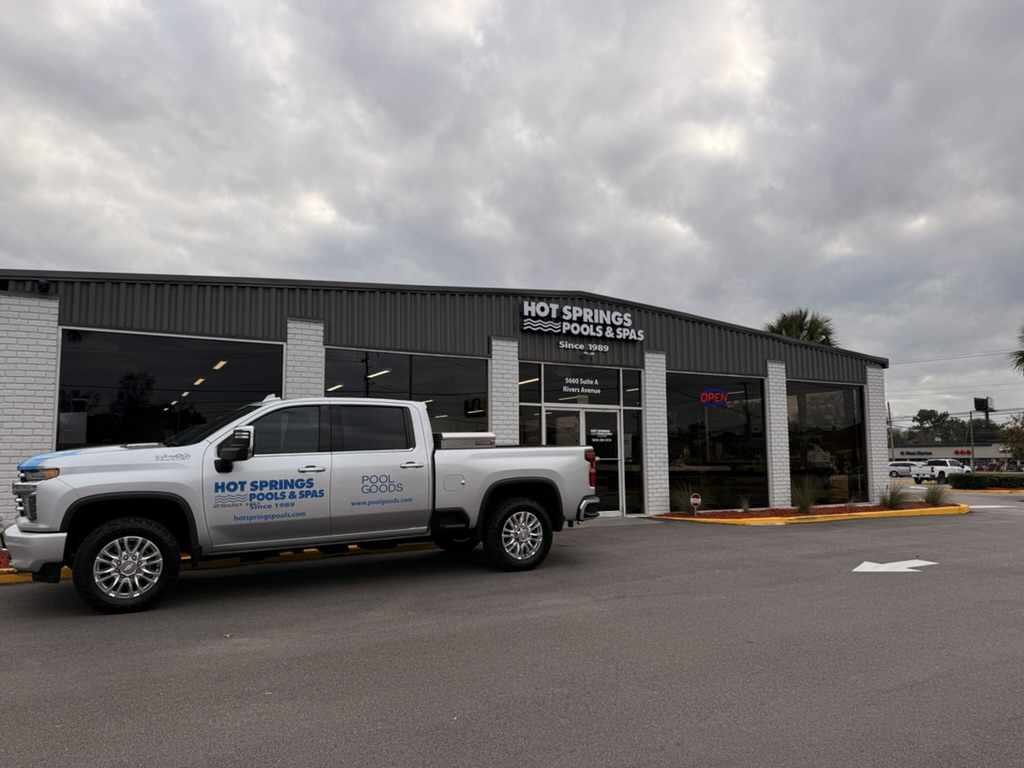
Our Hot Springs Pools & Spas showroom on Woodruff Road in Greenville carries Hot Spring and Caldera hot tubs and delivers throughout the Upstate, including Anderson, Easley, Greer, Mauldin, Simpsonville, Spartanburg, Clemson, and Seneca. Buying from a local dealer that services its own spas means you have someone to call for delivery, setup, and repairs, instead of being on your own after the sale.
How much does it cost to run a hot tub per month in the Upstate?
It depends on how the tub is wired and how well it is insulated. In our Upstate market, a single 50-amp setup typically runs about $30 to $100 a month depending on spa size, while the split 50-amp configuration we install (a 20-amp and a 30-amp circuit) typically runs about $8 to $25 a month. A 240V tub with good insulation costs much less to operate than a 110V plug-and-play model.
Do I need an electrician to install a hot tub?
For a 240V tub, yes. A licensed electrician installs the dedicated circuit, which is a one-time cost. A 110V plug-and-play tub avoids the electrician but can only run the heater or the jets at once and usually costs more to operate month to month, so most buyers who use their tub regularly are better off with 240V.
How many people does a hot tub really fit?
Fewer than the seat count suggests. A 7-foot by 7-foot spa lists the same seating as a 7-foot-5 by 7-foot-5 spa, but the 7x7 fits four to five adults comfortably while the 7'5 fits six to seven. Footprint and seat design matter far more than the advertised number, which is why we recommend sitting in the tub before you buy.
Is Hot Spring or Caldera better?
Neither is universally better. Both are made by Watkins and we carry both at our Greenville showroom. The right choice comes down to which seats, jets, and price fit you. We recommend trying both rather than choosing on brand name alone.
Should I buy a hot tub from a big-box store or an expo sale?
You can, but understand the trade-off. Those channels often have no local service team and limited parts access, so when something breaks you may have nobody to call. We treat being able to get service from the dealer you buy from as non-negotiable, and we suggest you do too.
About the author
Adrian Lozano is the Lead Hot Tub Specialist at the Hot Springs Pools & Spas showroom in Greenville, South Carolina. He has worked across multiple hot tub retailers and brands and helps Upstate homeowners choose, install, and care for Hot Spring and Caldera spas. Hot Springs Pools & Spas has served the Carolinas since 1989.
Ready to find your tub?
The best next step is to come sit in a few. Visit our Greenville showroom on Woodruff Road, or reach out for a quote or to request our buying guide. We will talk through your space, your power setup, and how you plan to use the tub, and help you compare options honestly, whether you buy from us or not.




.avif)

